Giuseppe Chiari
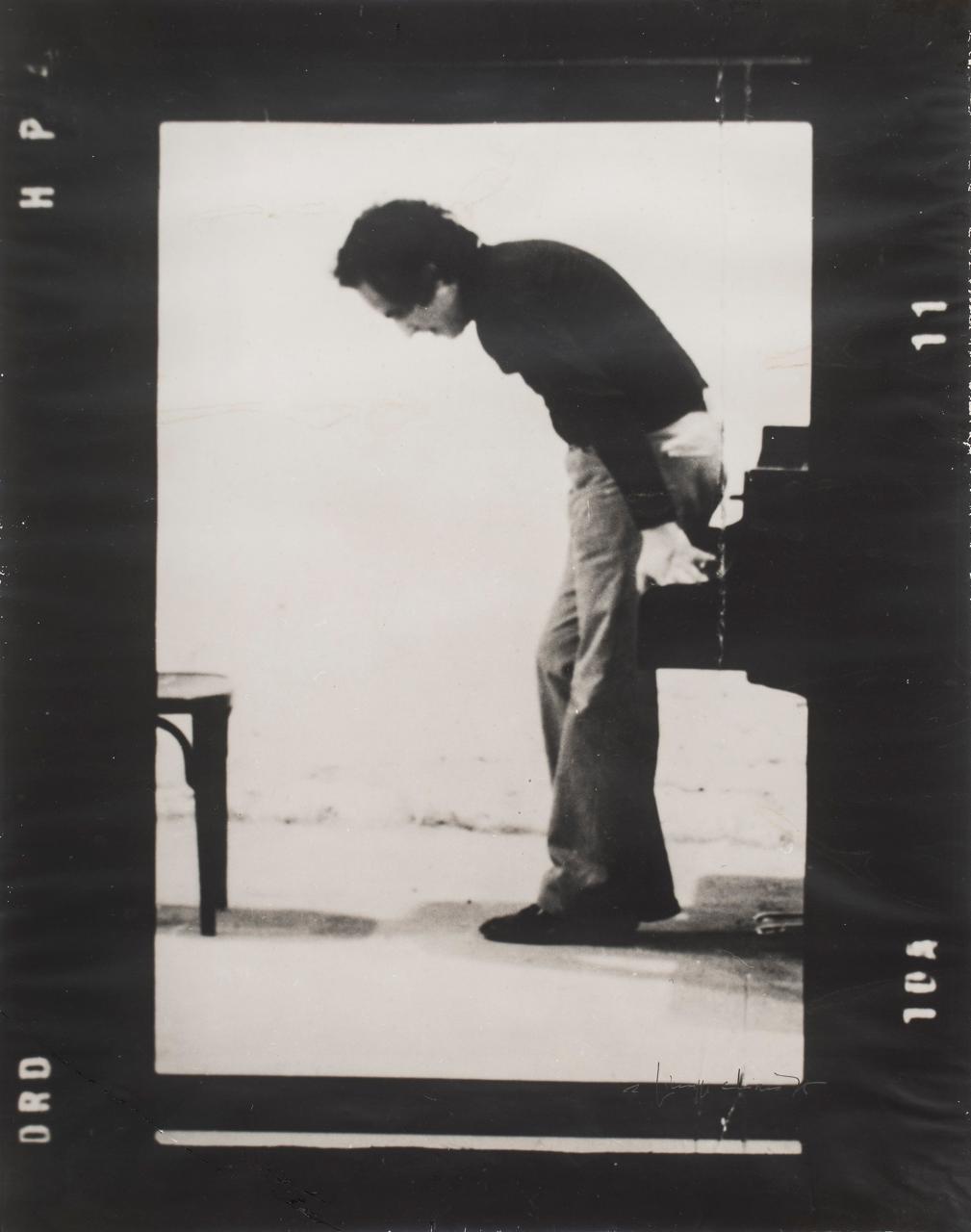
Born in Florence in 1926, Giuseppe Chiari studied engineering and trained as a self-taught musician, bringing a rational, almost mathematical approach to composition. From the 1960s onwards, however, that discipline turned against itself and became a radical critique of music as such: Chiari questioned the distance between those who compose, those who perform and those who listen, turning the act of playing into an action open to everyone. His name is linked to Fluxus, the international movement that dissolved the boundaries between art, music and everyday life. After the performance of Gesti sul piano (Gestures on the Piano) at the Wiesbaden festival in 1962 and the publication of La strada (The Street, 1965) by George Maciunas’s editions, Chiari became its leading Italian exponent. He was also a member of the Florentine Gruppo 70, which explored the relationship between art, communication and technology, and he took part in the international debate alongside figures such as Sylvano Bussotti, Frederic Rzewski and Charlotte Moorman. John Cage included him in the anthology Notations (1969), recognising the conceptual force of his graphic scores. From 1965 he developed the Metodi per suonare (Methods for Playing), in which instruments, objects and materials exchange their functions: the piano is played like any ordinary object, while water or a stone is played as an instrument. This line of thought extended to the environment, with projects such as Suonare la stanza (Playing the Room) and Suonare la città (Playing the City), and finally to his celebrated statements, short and disarming phrases written in capital letters on every kind of surface. Institutional recognition came with the Venice Biennale, to which he was invited four times (1972, 1976, 1978, 1984). In 1978 he chalked the phrase L’arte è una piccola cosa (Art is a small thing) on the wall, which became emblematic of his thinking. He also took part in Documenta 5 in Kassel (1972) and in numerous exhibitions in Italy and abroad, with solo shows in galleries and museums across Europe. Alongside his artistic work, he wrote books in which he ironically investigated the history of music theory, from Musica senza contrappunto (Music Without Counterpoint, 1969) to Dubbio sull’armonia (Doubt About Harmony, 1990). He died in Florence in 2007. In 2026, on the centenary of his birth, the MAMbo in Bologna dedicated to him the exhibition Partitura per un museo (Score for a Museum).